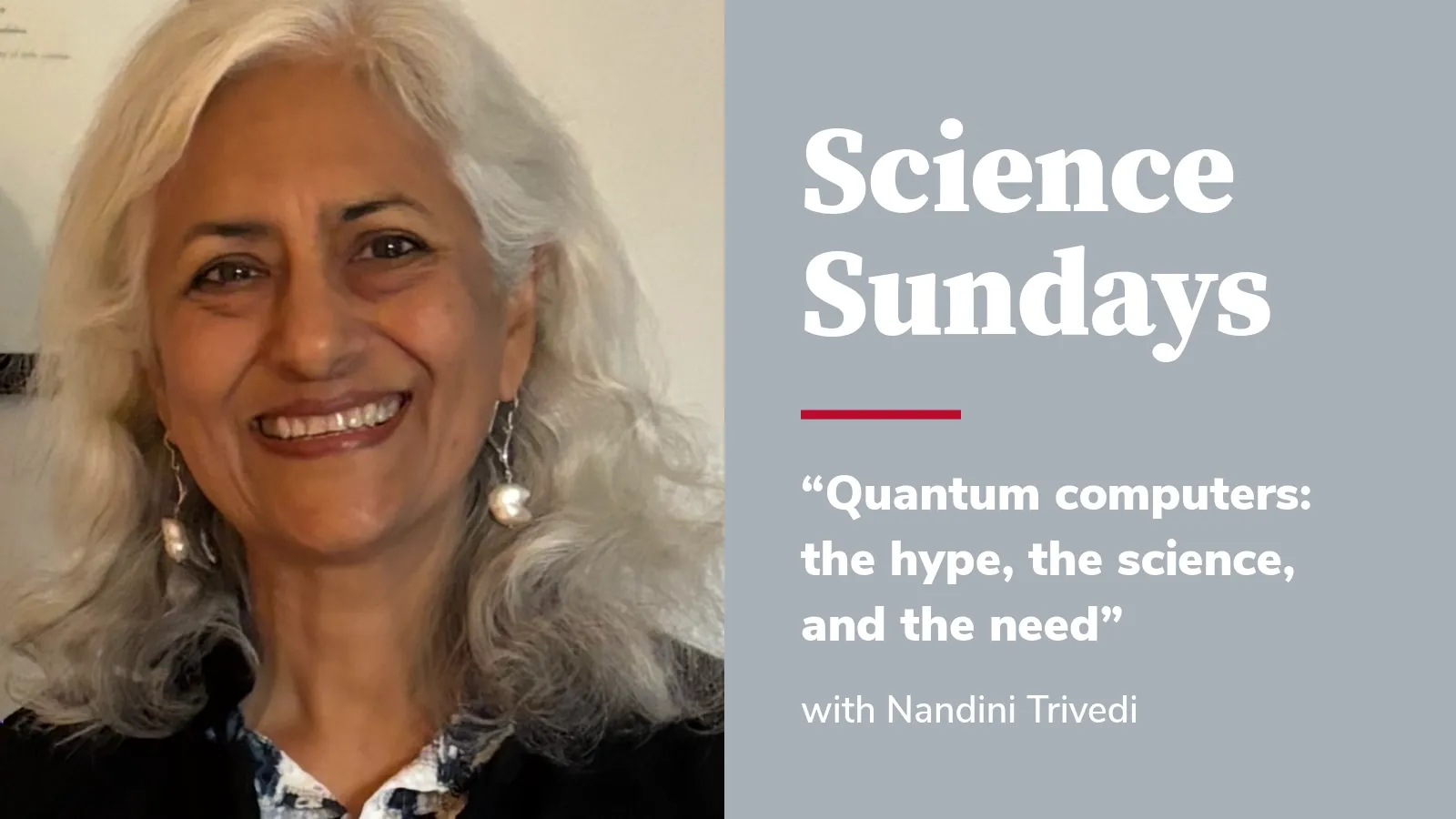
Classical computers — the kind that come to mind when we say "computer" — are extraordinarily powerful; they've sent people to the moon, mapped the human genome, and discovered new drugs. What then is a quantum computer and why do we need one at all? What is the difference between the fundamental unit of information in these two cases: the (classical) bit versus the (quantum) qubit? Why can't a classical machine ever fully catch up to a quantum one? And why are governments and companies pouring billions of dollars into quantum computing research right now? This Science Sundays talk will discuss these questions and more!
Nandini Trivedi is a professor in the Department of Physics and an Arts and Sciences Distinguished Professor at The Ohio State University. She received her undergraduate degree from the Indian Institute of Technology, Delhi and a PhD in physics in 1987 from Cornell University. After post-doctoral research at the University of Illinois at Urbana-Champaign and the State University of New York, Stony Brook, she joined Argonne National Laboratory as a staff scientist. In 1995, she joined the faculty of the Tata Institute of Fundamental Research, Mumbai. Since 2004, she has been a professor of physics at The Ohio State University. Prof. Trivedi’s research is in understanding emergent phases in quantum matter due to strong correlations and topology.
Dr. Trivedi on Voices of Excellence
View all Science Sundays lectures
Science Sundays is a free lecture series open to the public that provides a wide range of current and emerging topics and issues in science that touch our everyday lives. Speakers are experts in their fields from on campus and around the world with experience in making their topics interesting and accessible for audiences of all ages, with or without a science background.
Each lecture is followed by a free, informal reception from 4-5 p.m. Parking at the Fawcett Center is free for this event.
If you have questions about accessibility or wish to request an accommodation for a disability please contact John Beacom (beacom.7@osu.edu; 614-247-8102). With advance notice of two weeks, we can generally provide seamless access.