
When Brianna Thompson ’25 was creating her senior research project at The Ohio State University, she knew it had to be more than just a required assignment. She wanted her work to inspire and motivate young people.
Thompson combined her knowledge of interior design with research into mental health to create “Mindscapes,” an imagined space designed to foster emotional resilience, self-discovery and well-being among teenagers. The project is a response to the decline in adolescent mental health reported by the American Psychological Association, which found that social support for adolescents dropped significantly during the COVID-19 pandemic and has yet to recover.
“I wanted to design a mental health facility that didn’t feel too clinical and sterile,” Thompson said. “I wanted it to feel like a home for teens, a place to spark inspiration, curiosity and also a place where they can get help.”
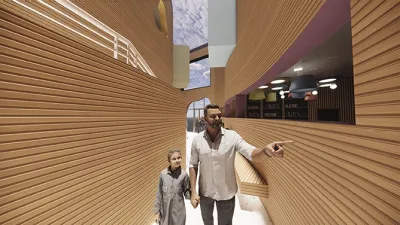
Her research focused on how color, biophilia — the human tendency to feel connected to nature — and nature-based elements impact mood, focus and overall mental well-being in adolescent teens. By combining psychology, design principles and environmental factors, Thompson’s goal was to develop a holistic space that empowers teens to navigate their mental health journeys with confidence and creativity.
Thompson was tasked with finding a hypothetical location for her project and then making her design come to life via design and rendering software. Her proposed location was the Franklinton Engine House 10, a historic landmark in Columbus. Through her research, she found that specific color palettes were important to include throughout the space.
“A lot of research shows that people feel calm and relaxed when they are outside in nature. So naturally green is a primary color that I utilized,” Thompson said. “Bright, vibrant, pastel colors make stress feel less negative and manageable. I found in our research that dark, muted, grayish colors make stress feel heavier or more negative. So, I primarily focused on nature in promoting mental health and physical well-being.”
The primary space within the proposed building is what Thompson calls a “canyon,” a space meant to serve as a common area where people can sit, talk and move about freely in a relaxed
setting. The canyon, which includes light wood walls, soft lighting and overhead windows, encourages connections, reflection and a sense of community for everyone who enters. The space creates a nurturing atmosphere that also encourages self-exploration and creativity.
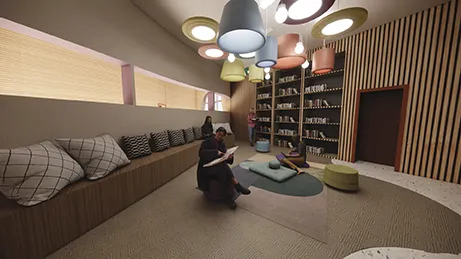
The idea for a canyon serving as the main welcoming space was the brainchild of both Thompson and Associate Professor of Design Susan Melsop. “(Melsop) was my teacher for the capstone,” Thompson said. “She’s been a big help. She helped me bring all my thoughts to fruition and made herself available anytime.”
Another associate professor, Rebekah Matheny, also helped Thompson with her research, which was presented at Ohio State’s 2025 Denman Undergraduate Research Forum.
“She was my second advisor for the research distinction portion of the project,” Thompson added. “She was willing to give me feedback, sit in meetings and she helped me get started on the research of color theory.”
The finished capstone project also featured a library nook, sensory pod and art therapy rooms to encourage curiosity and well-being. Thompson said if she had the ability to make her project become reality, it would mean a lot to her to implement it in her hometown of Youngstown, Ohio.
“I think mental health is something that needs to be talked about more,” Thompson said. “It wasn’t really talked about in high school. And I think this age range (13 to 17) is where we’re starting to understand ourselves. I think I can make an impact back at home.”
Photos: Brianna Thompson