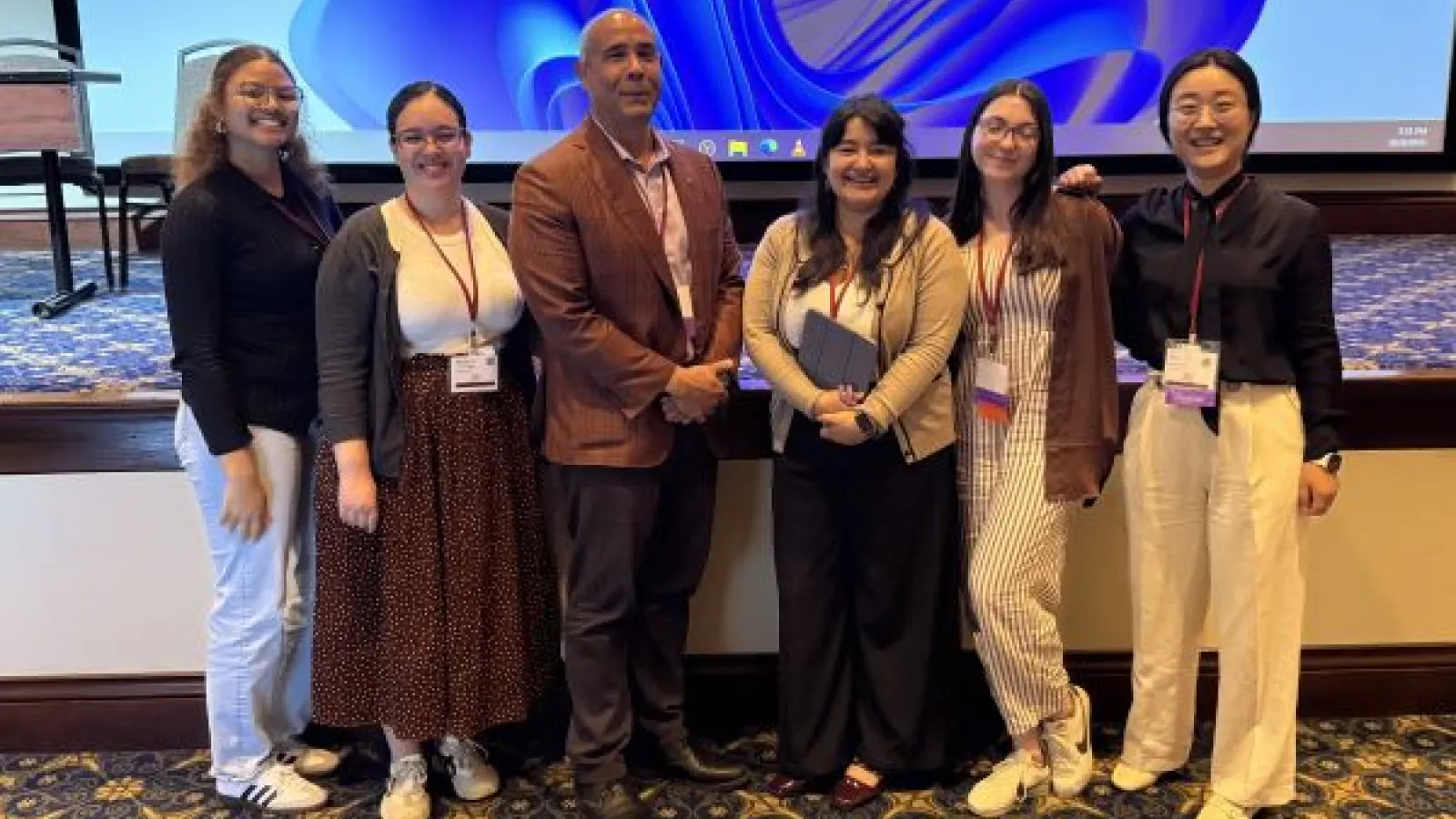
Arts and Sciences graduate students weave community connections into their work
Graduate students have a reputation for being solitary creatures, tucked away in a lab or in a corner of the library, diligently working away at a research project. But graduate education is more than mastering expertise in a specific discipline. Increasingly, collaboration and community engagement are essential to student success as graduate students look for opportunities that prepare them for their careers, whether that’s as a researcher or outside of academia.
In the College of Arts and Sciences, one option for building those skills and connections is a graduate fellowship program administered by the college’s Office of Engagement. Graduate Engagement Assistants (GEAs) work with community partners, in collaboration with faculty and staff advisors, to integrate their expertise into their partners’ work and in turn learn from experts in the communities that welcome them.
“This initiative responds to the need to prepare our graduate students for the workforce and to help them engage with partners beyond Ohio State,” said Maurice Stevens, associate dean for engagement. “Our aim is to support them with engagement-specific skills in collaborative research, relationship building, program development, outcome evaluation and more, while also building mentoring relationships inside and outside of an academic setting.”
In addition to regular conversations with their cohort and expert guests, the GEAs attend events such as the Engaged Scholarship Consortium conference and present on their individual work as well as on the program itself. As some of them complete their academic programs and graduate, they’ll also write a collaborative article on their experiences and on how the fellowship supported them and their community partners.
For Jasmine Hunt, a PhD candidate in the Department of Mathematics, the fellowship offers valuable professional connections and insights for her work, but it also presents an opportunity to meet people outside of her discipline who are interested in similar research topics and approaches.
“I’ve always been focused on bringing people together. My current research looks at social media networks from an interdisciplinary lens, which lends itself to this community-based way of thinking,” Hunt said. “In my discipline, I don’t have the space to talk with somebody who understands what I’m doing in terms of research. In this group, I can very easily say ‘this is what I’m doing’ and get more ideas for how to focus on the community.”
Other members of the fellowship cohort echo the value of finding like-minded people to discuss their research and support each other through their time in graduate school and beyond.

“Even though we all have our own particular lenses, I think there is this touch of an interdisciplinary approach that we all have in our work, and just even talking with the other members of the cohort, we've been able to help each other through different challenges of being in grad school,” said Iyana Hill, a master’s student in art education in the Department of Arts Administration, Education and Policy. “But also, I feel like it just became a safe space. That's one of my favorite things about what this space has become, a space for us doing this work and being able to relate to each other, reflect on each other and help each other grow.”
Growth within the cohort and in their field helps the GEAs better support the communities they serve. Fei Xie, a PhD student in the Department of Sociology, has studied mental health interventions in Hong Kong middle schools to determine whether these lessons influence students’ mindset about their own mental health, as well as their academic performance, and is continuing similar work with middle schoolers in Chinese schools. Working with both students and parents in a culture where mental health challenges carry some stigma, understanding ways in which she can engage them as partners and not just study subjects has made her work feel more impactful.
“Now I know more flexible ways or a broader definition of how you can collaborate and share knowledge to benefit the community,” Xie said. “I also have some parents reaching out to me when they don't know how to talk with their children, they think there's something going on, and they wonder if I can help.
“I feel like I'm really diving more into this community while I'm doing research. It might not have a direct effect, but when I'm communicating with people – and I also hold a small session with them about introducing the basic idea for my research – I can see many people echoing and reflecting. I think that's another way of building the bridge between knowledge and community.”
The students also acknowledge the need to future-proof their work by connecting it to more tangible community outcomes, or a desire to prepare for their own future careers through the GEA experience. For many, being able to better connect with the people and experiences they study is essential to shared success.
“For me, I think being a designer is trying to anticipate the future,” said Cidney Jones-Lawson, an MFA student on the research and development track in the Department of Design who studies fandom spaces and their culture around collectibles. “Continuing speaking with different communities is really important for whatever I see that comes next.”