Dynamite With a Laser Beam: Physics professor and his students use intense lasers for high-energy research


When you think of a laser, what comes to mind? Intergalactic space battles? James Bond in Goldfinger? A game of laser tag?
You may be surprised to learn that studying lasers at The Ohio State University is much more intense. Literally.
Douglass Schumacher has been studying lasers for almost 40 years. His study of light at such an intense level has been a passion since he joined Bell Laboratories after his undergraduate work, and today involves not just lasers themselves, but also protons, neutrons and electrons, the particles that make up atoms.
“The light that I study can generate interesting kinds of radiation, such as X-rays, beams of energetic electrons, ions or even neutrons,” he said. “We're seeing that laser-accelerated protons, that is protons accelerated by light, may be useful for new kinds of cancer therapies. What I would tell someone that's never encountered an intense laser before is that it's light that's so bright, it doesn't act like the light that they're used to anymore.”
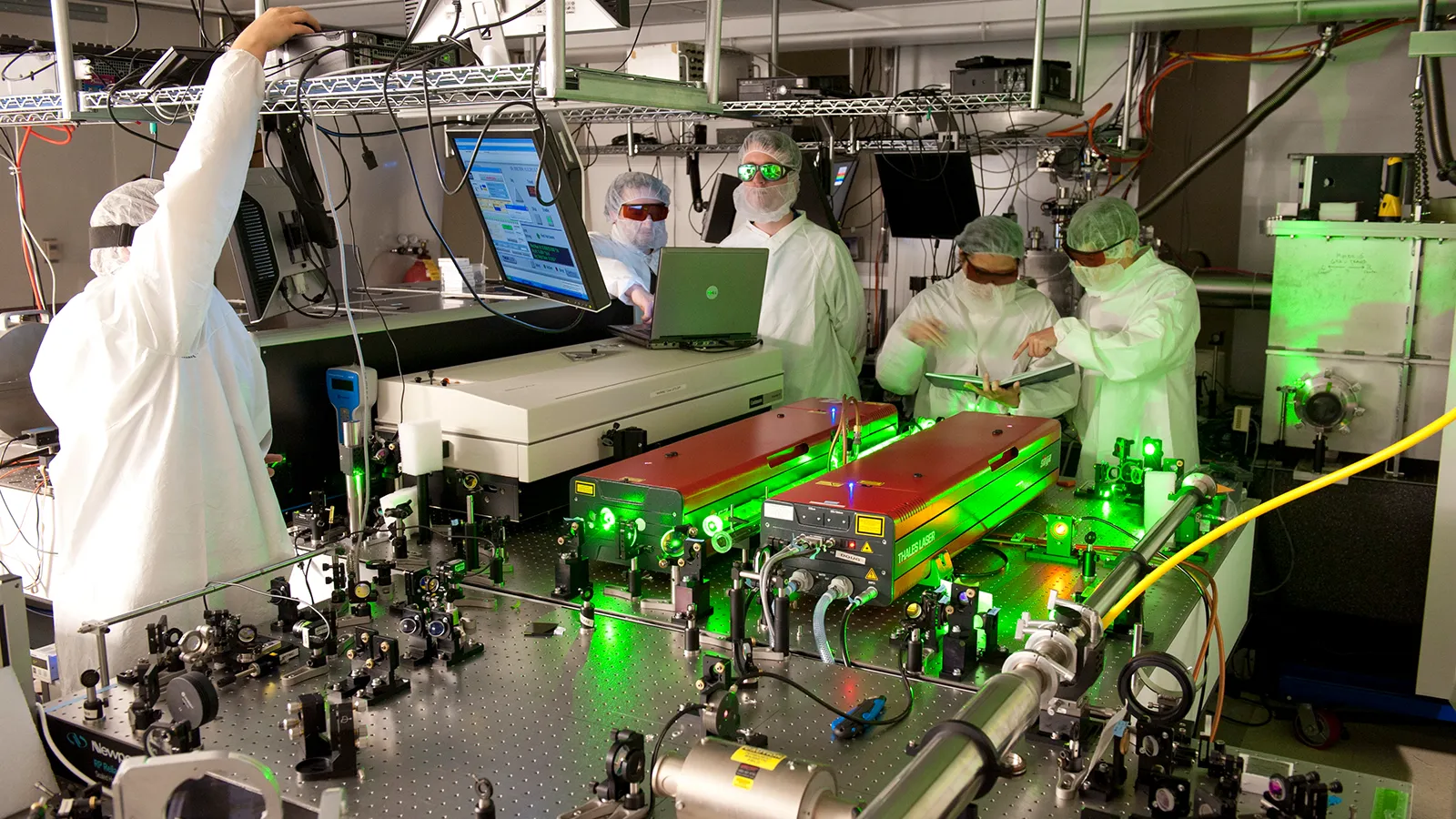
At Ohio State, Schumacher and his students work with the Scarlet Laser System at the High Energy Density Physics Scarlet Laser Facility. The Scarlet laser, which is part of the LaserNetUS network funded by the Department of Energy, can produce far more power in one shot than the world’s total electric power consumption.
The Scarlet laser was completed in 2012 and its construction was led by Enam Chowdhury, now an associate professor in the Department of Materials Science and Engineering. According to Schumacher, people travel from all over the country and even the world to utilize the Scarlet laser for various tests and experiments.
“One of the things that we're paid to do by the Department of Energy is to have people come from other labs, to do various experiments that advance the possible applications that you can use such intense light for,” he said. “So, part of the work that we do is as a user facility. And we've had people come from other countries and from other places in this country doing a wide range of different experiments.”
That said, Schumacher and his students also do plenty of research on their own with Scarlet, exploring proton acceleration and neutron generation, the effects of relativity on chemistry, and the development of plasma optics.
To put in perspective just how powerful the lasers in the facility are, Schumacher said that Scarlet is approximately “one hundred trillion times” more intense than lasers used for eye surgery.
The light from Scarlet is so intense that graduate student German Tiscareno was able to generate neutrons.
“Neutrons can be used to take pictures of things in the same way that the dentist uses X-rays to take pictures of your teeth. Neutrons can be used to look for, say, contaminants in manufactured goods,” Schumacher said. “One of the most powerful sources of neutrons is a nuclear reactor, and you can't exactly carry those around. But laser-based neutrons might be much more portable and safer to use.
“You normally think of light as passing through a pane of glass to go from the outside to the inside,” Schumacher added. “The light from Scarlet is so intense that it turns matter into a very hot plasma, much hotter than the surface of the sun. When you have that kind of energy bouncing around, that energy can go into unusual forms.”
As Schumacher and his colleagues continue their research, one thing they remain interested in is using the lasers to create mirrors out of plasma. These mirrors then disappear, which does not allow the light to reflect again and potentially harm the laser itself.
“The laser is so intense, it can turn matter into a hot plasma. That plasma is reflective and can act like a mirror, but with special properties that are useful to the scientific community,” he said. “We've just done an experiment where we show that plasma mirrors can reflect light to where you want the light to go, and then the plasma mirror goes away. The light can't find its way back to the laser and damage it. We call that a plasma mirror fuse. It's an effect that we just demonstrated in our lab.”
All of this work is not just done by Schumacher, but by his students, who get hands-on experience working with advanced equipment that will translate to any physics graduate program and many private sector careers they may be interested in.
“My students learn about advanced computation. We do our own computational modeling using the Ohio Supercomputer Center. And of course, my students are the ones that go into the lab and work with this kind of light,” Schumacher said. “They do so safely, protecting the laser and themselves and each other. This has been great training for these students, and they're doing great work. I advise, but the work was done by them and they find great jobs.”