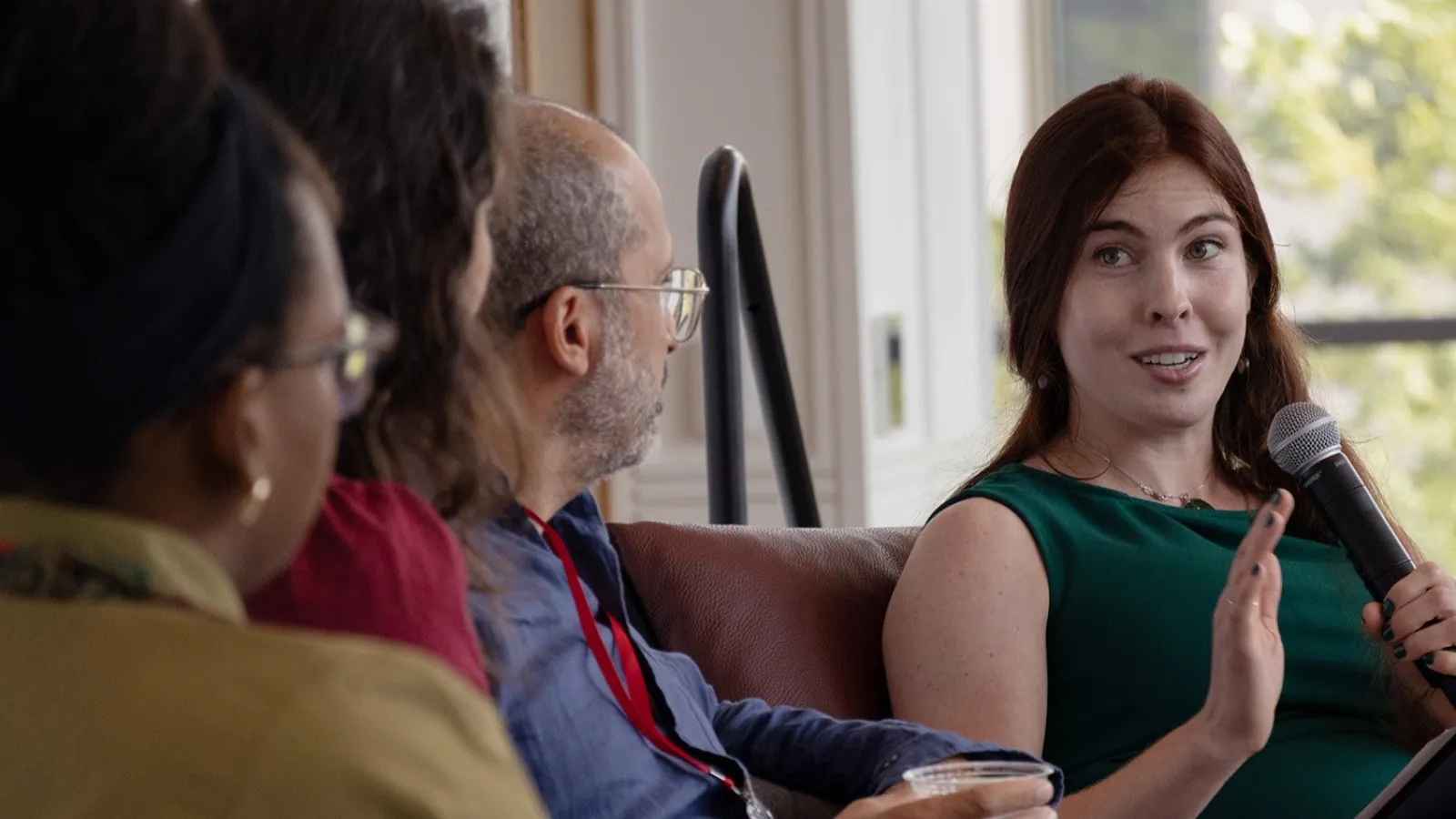
Expert panel discusses how to make AI work for the benefit of humans and society
“Will AI save or destroy us?” was the central question for a public panel on July 21, hosted by the Department of Psychology and the Collaborative on the Science of Polarization and Misinformation (C-SPAM) as part of a larger Mind & Machine Alignment Summit.
The summit focused on connecting artificial intelligence development to human values and well-being, and the public panel brought together experts in computer science, psychology and policy to examine what it takes to make AI a force for good in society.
While panelists were hopeful overall about the technology’s potential to benefit humanity, most also expressed caution and concerns about the current state of AI tools and their impact on people.
- Chinasa T. Okolo, founder of research institute Technecultura and a policy specialist at the United Nations Office for Digital and Emerging Technologies (ODET), discussed the disparities in AI resources and development between AI powerhouse nations, such as the United States and China, and the rest of the world. In addition, she explained how the fact that most training data for AI models comes from the U.S. introduces bias into the technology, which must be addressed through human oversight of AI tools and any decisions they make.
- Steve Rathje, an incoming assistant professor of human-computer interaction at Carnegie Mellon University, shared findings from several studies that showed humans prefer sycophantic AI, or chatbots that always agree with their users. These can reinforce extreme beliefs without people recognizing the chatbots’ confirmation bias. AI literacy efforts can make users more aware of the problem, Rathje said, but have little impact on how chatbot use affects decision making. The best way to address this problem will likely be “gently disagreeable” AI chatbots that offer counterarguments without direct confrontation.
- Abi Olvera, a former U.S. diplomat and current research director at the Golden Gate Institute for AI, discussed her research on whether chatbots could teach people how to make bioweapons. She concluded that “AI can’t replace the hands-on skills” required to do so, even if a chatbot provided instructions to human users. These findings inform resource allocation discussions within intelligence agencies, focusing their efforts on other forms of terrorism that are more likely to succeed.
- Michael Inzlicht, a psychology professor at the University of Toronto, introduced panel attendees to the impact of friction and effort on learning. He suggested that there needs to be a balance between using AI tools for schoolwork and maintaining a certain level of effort, which makes learning stick much more long-term. He also discussed loneliness and the effort involved in maintaining human relationships, and how AI can support relationship-building without replacing human connection.
“I think this will end up becoming a summit that we’ll hold every other year,” said Danica Dillion, a postdoctoral researcher in the Department of Psychology. “The talks were super engaging, and we got to hear a lot of different angles and speakers. It was amazing to learn so much about a technology that is quickly changing every part of our lives, maybe even what it means to be human.”
Dillion organized the event along with Kurt Gray, the department’s Weary Foundation Endowed Chair in Social Psychology, and Helen Devine, lab manager for Gray’s Deepest Beliefs Lab.
“The discussions connected us to the important work we are doing across the university, including in C-SPAM and the Translational Data Analytics Institute, and will develop insights for science and society,” Gray said. “The summit will also forge lasting collaborations, putting Ohio at the center of the conversation."
The panel also addressed some of the concerns that led to the development of Ohio State’s AI Fluency initiative, which will ensure that every Ohio State student will graduate AI fluent: fluent in their field of study, and fluent in the application of AI in that field.
“I was delighted that the College of Arts and Sciences could sponsor this event, just as we’re starting to implement AI Fluency, especially given the way that the speakers talked about the implications and ethics, and what to look out for in terms of risks, with AI,” said Ryan King, dean of social and behavioral sciences for the college.
“It gives us a great example of why we need that learning objective on responsible AI implementation. Hopefully all the students that were here can take that back to the classroom, and we’ve got an early start on AI Fluency implementation.”
A recording of the event is available on the panel website or as a YouTube playlist.
The Collaborative on the Science of Polarization and Misinformation (C-SPAM) at The Ohio State University facilitates research on the causes of polarization and misinformation and their potential solutions using an interdisciplinary scientific lens. C-SPAM is directed from within the Ohio State Department of Psychology, where it builds on a history of exceptional, innovative research about the human mind, brain and behavior. The collaborative began in 2024 with a generous gift from the Weary Foundation.