Scientists bring crop protection research to local science classes


As the world’s population continues to grow, farmers across the globe are working hard to feed more than 8 billion humans. Agriculture at that scale requires interventions, including herbicides and pesticides to keep crops healthy and free from disease and insect infestations. Chemical herbicides and pesticides were, and are, a common solution to these problems, but people are becoming more concerned about the environmental and health impacts of these products.
To address some of these concerns, Venkat Gopalan and Dehua Pei, professors in the Department of Chemistry and Biochemistry, and Guo-Liang Wang, associate chair and Endowed Professor of Plant Protection in the Department of Plant Pathology in the College of Food, Agricultural, and Environmental Sciences, are using funding from the National Science Foundation (NSF) to work together on a new generation of biocontrol agents that avoid some of the pitfalls of chemical products while still protecting food crops.
“There are several challenges to producing enough food, from climate change to having enough water to grow crops, and by 2050, we will have to produce 60% more food because of an increasing world population,” Wang said. “Scientists in many countries, including at Ohio State, are working on these challenges, and one key area is to minimize losses from major plant pathogens.”
Going back to middle school
But in addition to their work on protecting crops across the globe, Wang and Gopalan are also interested in something closer to home: showing kids that they can become scientists. A partnership with science teacher Jill Schneider’s classes at Jones Middle School in Upper Arlington, as well as with teachers in the Columbus City Schools system, gives them the opportunity to do just that.
“We thought that improving this age group’s interest in STEM is important, and this is a great way to do it,” Gopalan said.
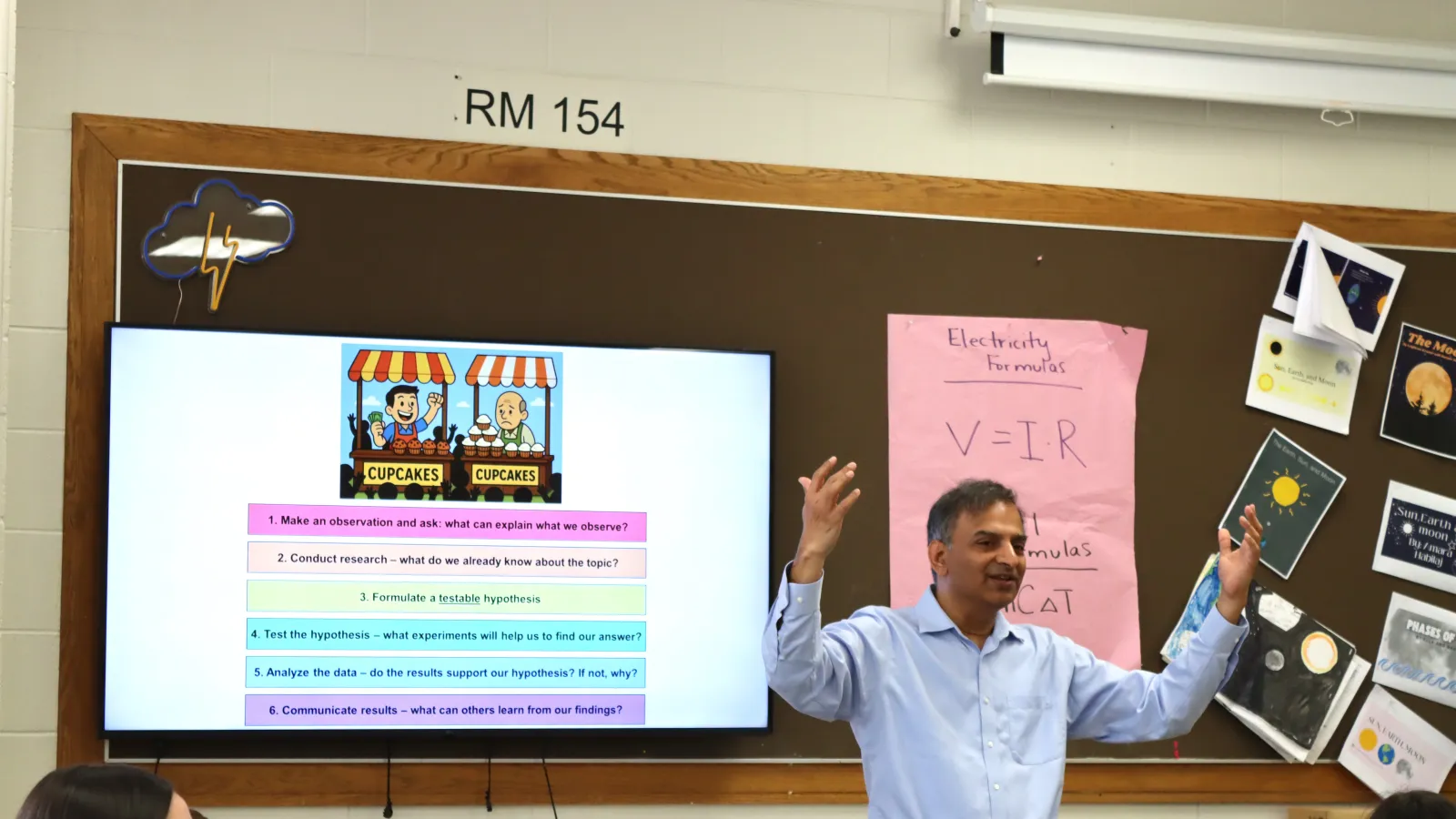
Along with team members Preeti Patel, Walter Zahurancik, Colton Jordan and Talia Collier, Wang and Gopalan visited multiple middle school science classes to present their research, introduce students to their research approach and to some commonly used personal protective equipment, and give them the opportunity to talk to professional scientists at a range of career stages and from a wide range of backgrounds.
The middle schoolers were shy at first, but after some coaxing, shouts of “rice!” and “wheat!” soon rang through the classroom when Wang asked them to name staple foods from across the world. They also enthusiastically volunteered for hands-on examples of the work happening in the researchers’ labs, from spraying plants with simulated biological protectants to working through the steps of the scientific method – making an observation, conducting research, formulating a hypothesis, testing it, analyzing data and communicating results – as part of smaller working groups.
“I had not done anything like this yet, but I feel that it’s very rewarding," Wang said after the school visits. "We received comments from the schools, and one hour of interacting with the students produced so much impact on them.”
Gopalan agreed and emphasized the importance of the partnership between the researchers and their partner teachers, in both Upper Arlington and Columbus City Schools.
“I've done some outreach before, but not at the level of middle school, and I have to agree with Guo-Liang that it was rewarding,” Gopalan said. “There were clearly challenges, and if we didn't have engaging partners, it would have been very hard to pull this off. The teachers are essential, so even if Ohio State faculty are willing, we cannot do any of this without a passionate school teacher.”
Looking ahead
Given the success of these classroom visits, Gopalan is also considering another set of programs that include faculty and students from the Department of Design and the Department of Chemistry and Biochemistry at Ohio State. Making the most of the partnership with Schneider and other Columbus-area teachers will continue to be part of the researchers’ work, benefiting both their graduate students and the middle schoolers they meet.
“It's important for all of us to connect with schools and with society in any way possible,” he said. “What better way to show the taxpayer that we bring back what we learn?”